
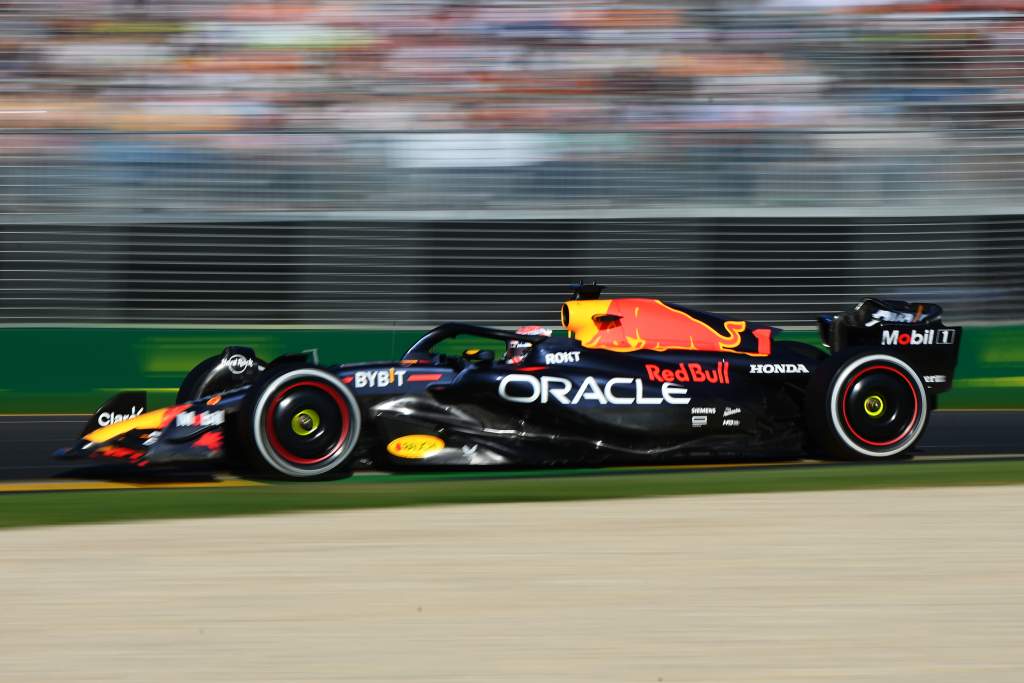
In recent years, discussions surrounding Formula 1 have frequently centered on Red Bull Racing's exceptional aerodynamics, particularly under the new ground effect regulations introduced in 2022. This engineering prowess has not only propelled them to the forefront of the sport but has also influenced other teams to modify their design concepts to align with Red Bull's successful strategies.
The impact of this shift is evident as rival teams like Williams and Aston Martin have reported significant performance gains after adopting similar philosophies. However, reliance on following a trend might lead to complacency. As Adrian Newey, Red Bull's Chief Technical Officer, emphasizes, there are times when innovation requires one to step away from the crowd: "If you always follow others, you will still end up behind them."
In a candid revelation from an exclusive interview with The Race last year, Newey spoke about the intricacies of the team's design process, particularly concerning suspension. While he delegated the majority of aerodynamic work to his talented team, he maintained oversight over how suspension choices integrated with aerodynamic principles. "I still had some input into the aero platform profile and its characteristics relative to ride height change," said Newey.
The interplay between downforce and vehicle stability is critical. Ground effect cars generate most of their downforce from the underbody, making it vital for them to maintain steady ride height during dynamic maneuvers. Newey explained, "When you consider that half a millimetre of front ride height change or one millimetre of rear ride height change would be used as a centre of pressure tuning tool, a couple of millimetres of random movement under braking could very easily have a major influence on the driver’s confidence."
The precision required in this context is striking. The regulations allow only minimal adjustments to the car’s center of gravity, approximately 1.5% change, translating to a mere 54mm on a 3.6-meter wheelbase. Newey noted, "But the teams will still use this small amount of movement to balance the car."
In the absence of careful control over these factors, the consequences could be severe. A vehicle that lacks stability can quickly become unmanageable, underscoring the importance of synergy within the overall design. “It is about making it all work as one,” he stated.
Red Bull Racing exemplifies this philosophy. High-performance F1 cars can experience deceleration forces exceeding 5g, with weight transfer resulting in load changes of over 250 to 300 kg on the front axle during braking. Thus, the objective is to mitigate transient effects as much as possible. Newey pointed out that the design choices around the wishbones are essential to achieving this, saying, "The height difference in the upper wishbone inboard pick-ups has a major influence on anti-dive, so in effect keeps the front of the car higher during braking."
This sophisticated engineering not only enhances performance but also naturally instills confidence in the drivers, allowing them to harness the car's potential more effectively. Newey’s insights reveal that the relentless pursuit of performance within F1 is as much about stability and predictability as it is about sheer speed.
As the 2023 season progresses and teams continue to adapt their strategies, Red Bull’s advancements in suspension design may well set a new benchmark in the sport, influencing both the immediate competition and the long-term direction of Formula 1 car development.