With the Brazilian Grand Prix set against a backdrop of rain, Pirelli's insights suggest that the tire strategies will be heavily influenced by wet conditions. Teams are poised to tackle a fully wet race, which alleviates the requirement to utilize multiple slick compounds. However, the strategic complexity remains intact, particularly in tire pressure management and grip levels.
"If the rain is similar to this morning, the intermediate will be the race tire, unless there are especially heavy rain phases," stated Simone Berra, Pirelli’s Chief Engineer, just hours before the race. This insight reflects Pirelli's experience from previous wet conditions, where the full wet tire is rarely employed due to visibility concerns.
The intermediate tire is anticipated to render the best performance under these circumstances. Berra elaborated, “The intermediate also performed well in qualifying laps, with no major abrasion from the new asphalt and only moderate wear. There is some thermal degradation, but with enough standing water, it could extend the stint on the intermediate.”
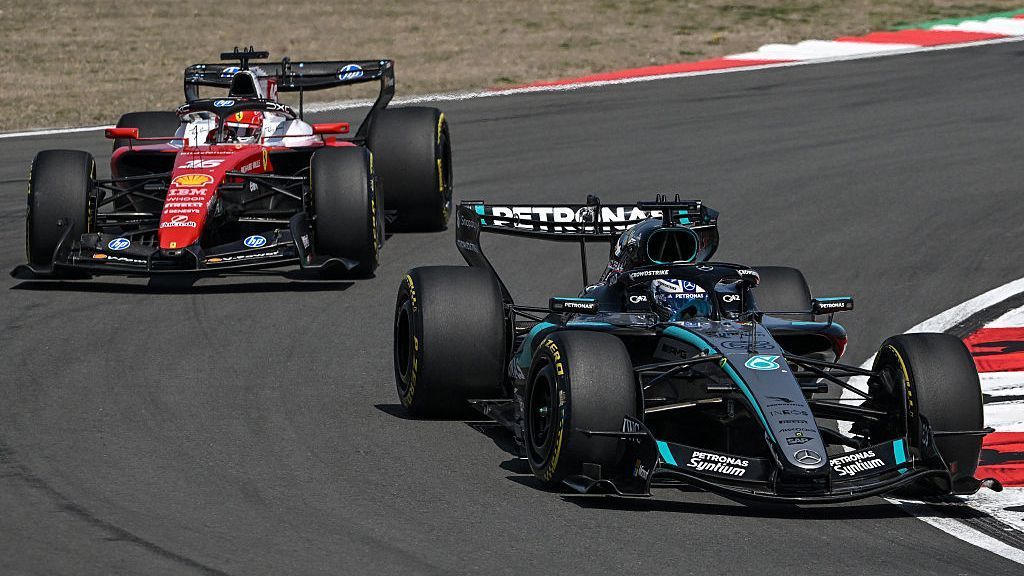
-competes-with-Ferraris-Monegasque-driver-Charles-Leclerc.jpeg?trim=0,0,0,0&width=1200&height=800&crop=1200:800)
Predictably, a tire change seems inevitable in this race. Berra noted, "If it rains for the entire race, there’s always the question of whether to do a single or a double pit stop. It will depend greatly on the amount of water on track. With more water, a single stop may be possible, while with a drying track that may get wet again, a two-stop strategy might be preferable."
Another significant factor influencing race strategies is tire pressure. Pirelli advises that getting this right is crucial in wet conditions. "Depending on the track temperature and water levels, it’s advantageous to raise or lower the pressures accordingly. Engineers face a challenge in achieving optimal performance in changing conditions," Berra explained.
As the weather fluctuates, particularly with heavy rain anticipated, the interplay between pressure settings and water evacuation becomes vital. Berra noted, "When there’s a lot of water on the track, higher pressures are better, as they open the tread blocks a bit and help evacuate water. Lower pressures provide a larger contact patch but don’t clear as much water, increasing the risk of aquaplaning."
Teams have conducted various tire pressure strategies in qualifying. "In qualifying, some teams went with pressures higher than our minimum recommendations, while others stayed at the baseline. Either way, this made a difference," Berra remarked. Looking ahead to the race, he anticipates that many teams may favor minimum pressures to avoid the risk of thermal degradation during longer stints, saying, "I expect fewer teams to use high pressures, as this causes greater thermal degradation over longer stints, leading to more sliding."
Beyond tire selection, the condition of the track itself adds another layer of uncertainty. The resurfaced circuit, laden with bitumen and oil, poses challenges for grip under wet conditions. Berra emphasized, "It should be an interesting race, as the asphalt is not in ideal condition with the rain. A wet race will be interesting, as driver skill will play a big role here."
While meteorological predictions continue to hold potential for drying conditions during the race, Berra advises caution regarding tire choices. "If there is a dry window, it will be interesting to see which compound teams choose. I’d rule out the soft tire because it tends to suffer from graining on a track with so little rubber. Teams will need to assess whether the medium or hard would be better, considering that the track has been fully reset and washed by the rain over the past two days," he concluded.
As the teams gear up for the race, embracing the uncertain elements will be key to navigating the challenges presented by both the weather and track conditions. With tire strategy playing a pivotal role, teams must stay agile in their decision-making to adapt to the evolving race landscape.