
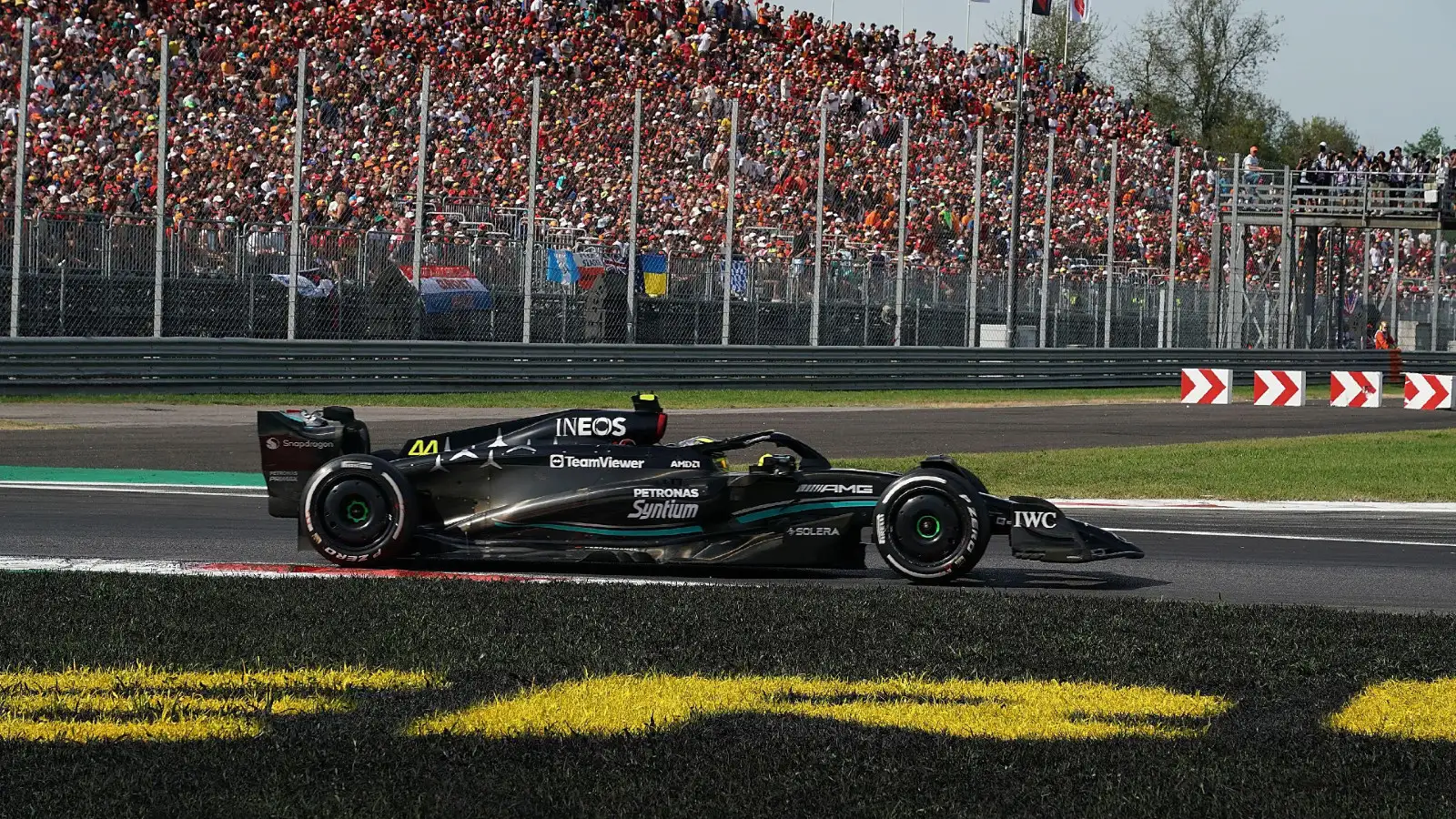
During the recent Italian Grand Prix at Monza, Lewis Hamilton's unconventional strategy was a topic of discussion among F1 fans and analysts alike. The seven-time world champion opted to start on the hard compound tyre, distinguishing himself from many competitors and positioning himself to maximize his potential in the race.
Hamilton lined up eighth on the grid and demonstrated his skill by moving up to sixth place. He was just over 20 seconds behind his teammate George Russell, who used a commonly adopted strategy by starting on the medium compound from fourth place.
Mercedes' trackside engineering director, Andrew Shovlin, elaborated on the team's thought process behind this distinctive choice. "We do a lot of simulations and look at the scenarios where we start on medium and hard," Shovlin noted during the team’s post-race debrief. "One thing we were seeing with the hard was the potential upsides were actually bigger."
The decision to employ the hard tyre was rooted in generating a strategic advantage. Shovlin pointed out, "Lewis’s chance of getting a very good result was increased if we offset strategy and went for that hard tyre." Monza posed particular challenges for overtaking, as the circuit features long straights combined with high-efficiency, small rear wings. "The DRS effect at Monza therefore is less than half of what it is at most other circuits," Shovlin explained, emphasizing that without a difference in tyre age, overtaking becomes very difficult.
Hamilton's entire strategy revolved around creating a significant difference in tyre age compared to his rivals. "We were able to run him longer, and he was then on a fresh medium at the end of the race when all the other cars – the McLarens, the Williams, and Alonso were on their older Hard tyres. That was enough to generate the overtaking delta that he was able to get through," Shovlin stated.
The strategy also considered the potential for a Safety Car intervention, which had been prevalent in other racing categories during the event. Shovlin indicated that the timing could have been favorable for Hamilton if the Safety Car had emerged while he remained on the hard tyres. "There were points in the race where a Safety Car would have been very beneficial to Lewis," he explained. However, that scenario did not materialize, and while Hamilton ultimately finished in sixth place, Shovlin regarded it as the best possible outcome given the circumstances.
The first start of the race was aborted due to a mechanical issue with Yuki Tsunoda’s AlphaTauri car, which allowed teams to reconsider their initial strategies. However, Shovlin reiterated that Mercedes was committed to their plan. "Would we have wanted to change? No, we wouldn’t because what we were actually trying to achieve was an offset to most of the field to try and make sure Lewis was on a different strategy," he said. The majority of cars started on mediums, which aligned with Mercedes’ strategy goals.
As the season progresses, teams will continue to adapt and optimize their strategies based on the nuances of different tracks and changing race dynamics. The unique approach taken by Mercedes at Monza exemplifies the intricate decision-making that is central to success in Formula 1. With engineers and drivers alike continuously analyzing data and scenarios, fans can anticipate even more surprises as the championship enters its closing stages.