Mercedes has set its sights on improving the aerodynamic stability of its W14 Formula 1 car for the 2023 season. Technical director James Allison recently shared insights on the team's strategic direction during a press briefing in Baku. "We’ll be trying to improve the balance of the car,” he stated. “I think probably there isn’t a car out there with a perfect balance and ours is very much less than perfect and we’ll be trying to work on that, aerodynamically and in terms of platform control, with the suspension."
Allison's comments came in conjunction with previous remarks from his predecessor, Mike Elliott. According to Elliott, the upcoming update of the W14, expected to debut in Imola, will include revised sidepods. However, these updates will not align with the heavily undercut designs prominent on Red Bull cars. This suggests that Mercedes is committed to refining its own design philosophy rather than pivoting to a redrawn aerodynamic scheme.
The aerodynamic advances seen in Red Bull's car, attributed in part to their unique anti-dive front and anti-squat rear suspension geometries, have created a significant competitive edge. These technical specifications allow for less pitch and dive, enabling the car to run closer to the ground and enhancing underbody efficacy through ground effect venturis.
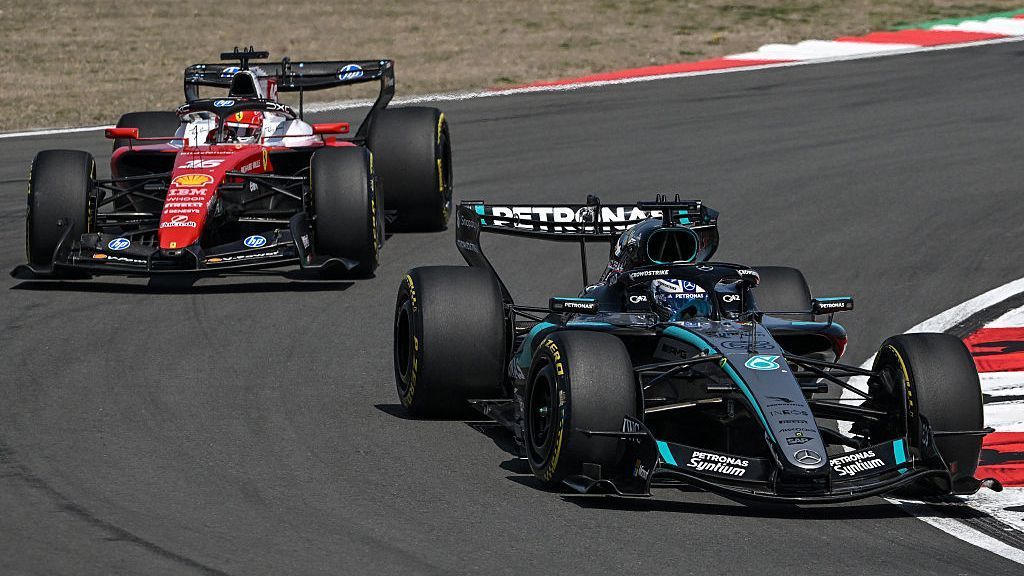
-competes-with-Ferraris-Monegasque-driver-Charles-Leclerc.jpeg?trim=0,0,0,0&width=1200&height=800&crop=1200:800)
However, Allison acknowledged the difficulties of implementing such radical geometry changes in the existing W14 chassis. "Even if Mercedes cracked that code, the W14, as currently configured, would need to be totally re-engineered to achieve that suspension as it would impact upon suspension pick-up points of the chassis,” he explained. This indicates a complicated balancing act for the team, as they must enhance performance without overhauling their entire design.
The challenge intensifies when considering the operational constraints of F1. Implementing a Red Bull-style body layout, for instance, would require changes not only to the suspension but also to the gearbox length, radiator placement, and even cockpit positioning. In the context of the current cost cap regulations, such fundamental alterations are not feasible during the ongoing season.
Consequently, the current aerodynamic configuration of the W14 is likely to persist for the remainder of the season. "I don’t think any of us would ever consider a wholesale clean sheet revamp to be a good or prosperous approach,” Allison remarked. “If the rules change, you have to change with them. But engineering is about iteration and in all likelihood if you tear things up you are… I’m going to mix metaphors horrifically here, but you are going to just throw away an awful lot of baby along with a small amount of bath water."
This brings us to intriguing questions about the direction of Mercedes’ 2024 car. The decision-making process regarding whether to embrace a more Red Bull-like aerodynamic style will hinge on several critical elements, including monocoque shape, suspension pick-up points, and gearbox dimensions. Early decisions will be essential, as they will guide the trajectory of the team's future designs.
In an environment where technological innovation is paramount, Formula 1 continues to engage fans with its relentless drive for evolution. The ongoing 'tech war' between teams remains a fascinating aspect of the sport. As teams seek to outpace one another, understanding the intricacies behind their designs becomes crucial for fans eager for insights into their favorites.
With teams like Mercedes under pressure to enhance their cars, the quest for victory will undoubtedly fuel further advancements, setting a dramatic stage for the rest of the 2023 season and beyond.