
Mercedes faced a challenging start at the Belgian Grand Prix, where new upgrades failed to deliver the expected performance as they struggled during practice sessions. The team’s quick pivot to revert to an older configuration proved to be a transformative decision for the weekend.
The W15 arrived in Spa after two victories in three races, boasting a fresh upgrade package that included significant changes to the floor and diffuser. Minor adjustments were also made to the front wing and the halo, all aimed at increasing speed.
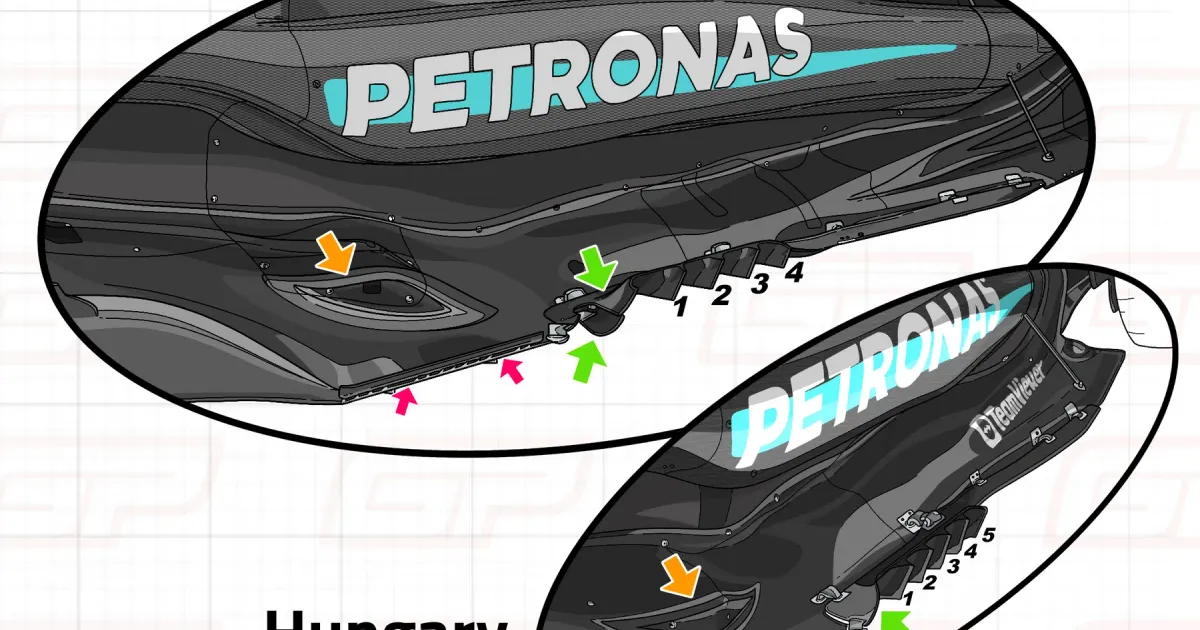
Among the notable modifications was a new floor design that mirrored features adopted by Red Bull, reducing its vortex generators from five to four. Additionally, the revamped design incorporated two small fins at the front edge of the floor connected by a metal support. This shift is indicative of Mercedes' focus on enhancing airflow management and downforce.
Moreover, changes to the rear ramp of the diffuser aimed to elevate airflow extraction and boost downforce generated by the Venturi channels. According to Andrew Shovlin, Mercedes’ Trackside Engineering Director, “It’s mainly about more downforce; we’re not looking for any different characteristics from it really.” Shovlin further acknowledged the challenges of translating such enhancements into tangible performance during racing conditions, “...when you’re developing, you’re not completely in control of what you get.”
The intricate dynamics of ground-effect cars currently presenting a challenge for various teams signal a peak in mechanical development possibilities. Mercedes, along with other competitors like Ferrari and Aston Martin, recognizes that while increasing downforce can lead to performance gains, it can also strain mechanical systems, resulting in performance issues. This was particularly evident as the W15 experienced excessive bouncing during the practice sessions, making the car unstable and increasingly difficult to handle.
Shovlin articulated the frustrations of the night before qualifying: “We are losing time across the full speed range, rather than in specific corners; the long run isn’t where we need it to be either. Both of those are linked by a lack of balance and grip.” This prompted the team to make a critical decision: instead of pushing the new upgrades that risked the entire weekend's success, they opted to revert to the previous W15 configuration that had shown promise in the Hungarian race.
By the time qualifying commenced, both Lewis Hamilton and George Russell returned to the old specifications, resulting in a car that was admittedly “draggy” but much more stable. This transition allowed them to adjust their performance effectively amidst changing weather conditions, which included cooler temperatures and rain.
The strategy not only salvaged their Saturday but set the stage for Mercedes' win on Sunday when Hamilton claimed the lead, marking a significant turnaround for the team. The outcome at Spa displayed not just the effectiveness of reverting to a familiar configuration but also emphasized the unpredictability inherent in racing.
In the ever-evolving world of Formula 1, where teams continuously strive for advances, the case of Mercedes at Spa serves as a reminder that sometimes stepping back can pave the way for forward progress. As teams analyze every nuance of car performance, this victory could reignite confidence moving into the next races, showcasing the delicate balance between innovation and reliability.