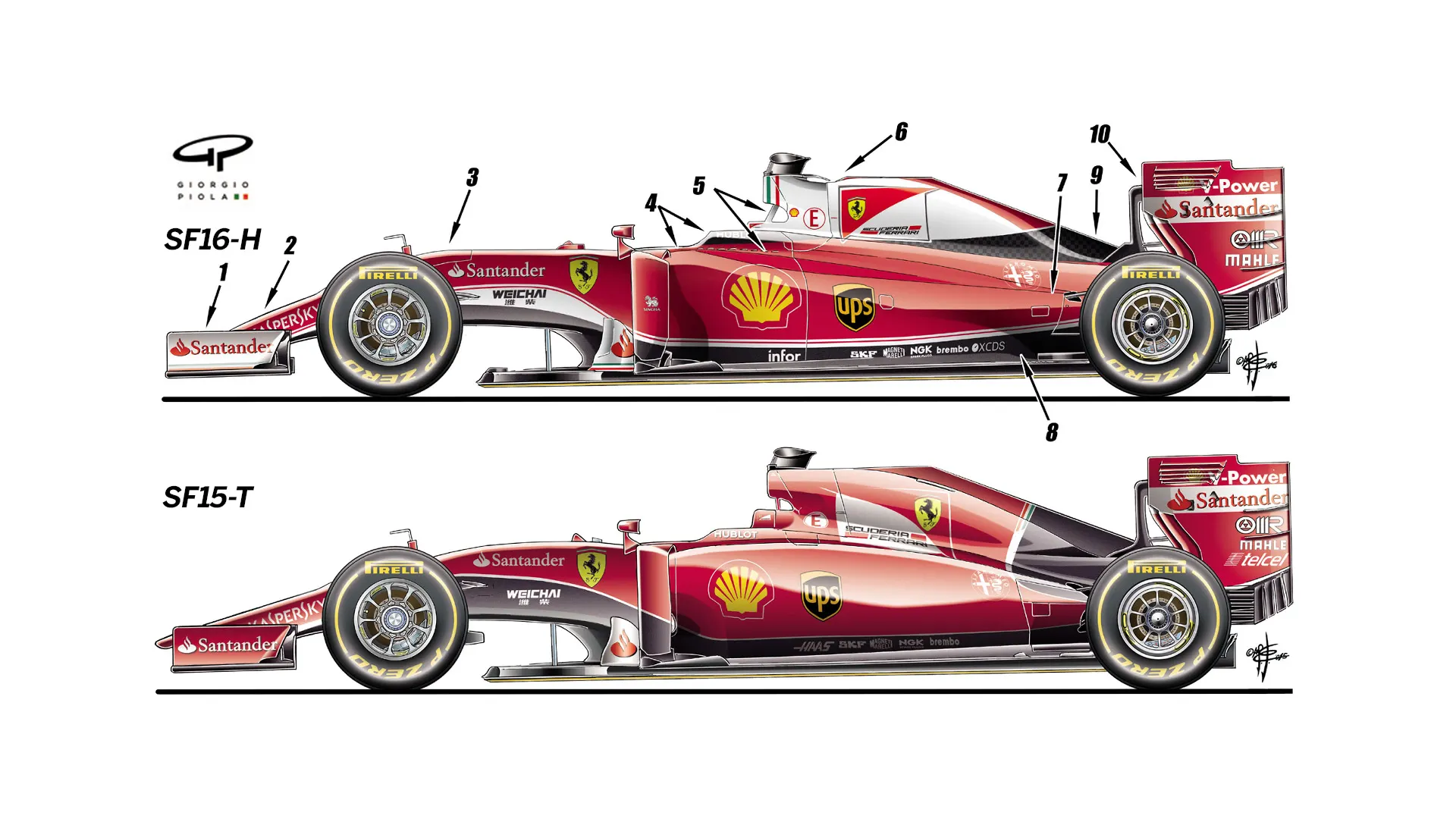
The 2016 Formula 1 season has commenced with Ferrari’s SF16-H making a remarkable impression, beginning with Sebastian Vettel leading the morning session times on its debut. As the team focuses on refining their performance, a closer look at the car reveals significant updates that differentiate it from its predecessor, the SF15-T.
This year, Ferrari has adopted a short nose design that resembles the successful look pioneered by Red Bull Racing. "The new design will aid airflow under the car," noted technical illustrator Giorgio Piola, who elaborated on several changes that enhance the aerodynamic efficiency of the SF16-H. The transition to this style reflects a strategic decision to maximize downforce and stability, crucial elements in competitive racing.
Retaining some elements from last year, Ferrari has opted for the previous front wing and the blown front axle setup, while also introducing a chassis that is higher and straighter in shape. This modification includes a vanity panel that seems to hint at a potential S-duct solution for future races. "They seem to be gearing up for more advanced aerodynamic strategies," observed Piola.
-competes-with-Ferraris-Monegasque-driver-Charles-Leclerc.jpeg?trim=0,0,0,0&width=1200&height=800&crop=1200:800)
The revised sidepods play a crucial role in compliance with new regulations, which now necessitate that cockpit head protection be elevated by 2 centimeters. As a result, the sidepods are designed to be taller and more seamlessly integrated with the chassis. This adaptation helps in maintaining airflow management while keeping safety as a priority.
In terms of cooling, the car has been equipped with ten small hot air vents located beside the cockpit. Moreover, the new oval-shaped airbox is engineered to sit higher in relation to the driver’s helmet. "These adjustments reflect a thorough understanding of thermal dynamics at play in modern Formula 1,” added Piola, emphasizing the intricate nature of these developments.
Moving to the rear of the SF16-H, the sidepods have been optimized for reduced height, efficiently channeling hot air expelled in the area of the rear suspension. Key components have been redesigned, including a compact gearbox that no longer incorporates the MGU-K. However, it boasts an innovative clutch positioning that could alter race strategies moving forward.
The rear portion of the engine cover showcases a new shape, distinct from its predecessor’s, which adds to the overall aesthetic and aerodynamic profile of the car. While the team has implemented considerable changes, they opted to keep the rear wing design consistent with that of the end of the prior season for the launch phase.
When looking at the car from the front, the updated shorter nose design is evident, along with more complex, vertically arranged front wing pillars. Furthermore, the transition from a pullrod suspension to a pushrod front suspension system signals a shift in engineering philosophy. "These design tweaks could provide better handling characteristics and tire management during races," Piola commented, highlighting the technical implications for Ferrari’s racing strategy.
As the testing progresses, Ferrari is optimistic about the SF16-H’s performance, aiming to challenge for the championship title this season. With new designs and updated engineering, the team is set to capitalize on the technological advancements injected into the car.
In conclusion, Ferrari’s SF16-H aims to propel the team forward in a competitive season, with its refined aerodynamics and clever modifications setting the stage for a strong campaign. As rivals continue to adapt, all eyes will be on Ferrari to see how these changes translate into real-world performance during the races ahead.